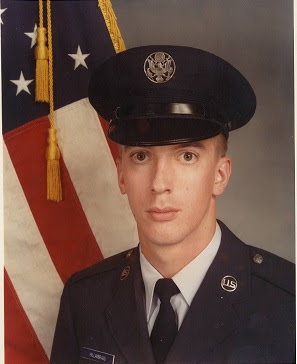
This flag draped Uncle Tom Hillanbrand and my Dad's caskets. I'm saving it to drape mine and my brother, Mark, in the end. I don't think any other flag would do. It would be nice to have it draped on my Uncle Charlie's casket, if he ever comes home.

Corporal Charles R. Hillanbrand, Company I, 3rd Battalion, 17th Infantry Regiment, 7th Infantry Division, was listed as Missing in Action, while fighting enemy forces on Pork Chop Hill in North Korea on July 9, 1953. On February 10, 1954, his status was changed to presumed Killed in Action Remains Not Recovered. He was awarded the Purple Heart & Combat Infantry Badge.

As Veteran's Day approaches, I would like to recall the service of my Great, Great, Grand Uncle George William Huth. His record as a Civil War veteran is quite interesting. He entered the service on December 2, 1861, as a private of Company A, Pennsylvania Volunteer Cavalry, and was detailed to Pottsville as a member of the recruiting service from April 3 to 27th, 1862 as an acting sergeant. He was promoted to Artificer of October 27, 1863. During the war he served with the First Brigade, Second Division, Eighth Corps of the Middle Department, from February 3 to July 8, 1863, being transferred then to the Second Brigade, Second Division, Cavalry Corp of the Army of the Potomac, remaining in that brigade till February 17, 1865, when he was transferred to the Third Division of the Cavalry and Military of the Mississippi Army, remaining with that division till July 8, 1865. During the war, Mr. Huth was twice captured, the first time on June 15, 1863, at Winchester, Va., and he was imprisoned on Belle Isle and at Castle Thunder, in Richmond. He was again captured at St. Mary's Church, Va., and imprisoned in Richmond, Danville, Andersonville, Charleston, Savannah, and Florence Hill Prisons till March 1, 1865. He was injured in a fall from his horse on February 14, 1864, his head being injured in the fall. Mr. Huth was discharged from the service on June 1st, 1866. He later was employed as a miner in Schuylkill County. He died on January 12, 1929 at the age of 90, survived by nine grandchildren, seven great grandchildren and several brothers and sisters including, Mrs. Elizabeth Hillanbrand.

 |
| Artist rendering of Salisbury Prison Hospital |
 |
| Salisbury National Cemetery |
 As Franz Hillanbrand acclomated himself to the region, he took up residence in Pottsville, PA. We know through the Recorder of Deeds Office of Schuylkill County that he had purchased two residences in town located at 60 Market Street and 66 Norwegian Street. Unfortunately, Franz lost both homes do to a fire and with no insurance, he was in debt for the rest of his life. On July 22, 1851, Franz married Magdalena B. Zernhelt in the St. John the Baptist Church, pictured in this article. Magdalena was the fourth child of Francis Anthony and Gertrude (Holzmann) Zernhelt. Originally from the Alsace-Lorraine region, the Zernhelt family were of German descent. Anthony and Gertrude had five children, three (Mary, Anthony and Enos) were born in Germany and two (Magdalena and George) were born in America. So, as far as the Hillanbrand family, Magdalena was the first ancestor born on American soil on June 18th, 1833.
 During the Civil War, Franz Hillanbrand enlisted in the Pennsylvania State Militia during the South's incursion into Pennsylvania. He was a Private in the U.S. Army, 19th Regiment, P.S.M. This unit was formed quickly, because of Lee's aggression in Gettysburg. The Governor of Pennsylvania asked for volunteers to prevent a further push into Pennsylvania by the Confederate Army. After the war, Franz Hillanbrand left his position at the Bulls Head Colliery to work at the Potts colliery, at Wolf Creek, near Minersville, Schuylkill County, where he worked for sixteen years, or until 1870. He then moved to Ashland, Schuylkill county, and worked at the Tunnel colliery, for two years, coming to Mahanoy Plane in 1872, and working as engineer there up to 1893, until a couple of months prior to his death on October 14, 1893.
.jpg)


 The picture on the right is the only photograph that I was able to identify as the ship "Emigrant". Though it appears to have seen better days, this photograph was taken at Bristol, England when it ran aground. Franz Hillenbrand boarded this ship (actually called a barque or bark) to emigrate to America. A barque is a three masted square rigged sailing ship that traversed the Atlantic Ocean.
 I ponder why Franz Hillenbrand would leave this small community of farmers in the year 1847. The political and economic situation was dynamic during this period of Germany's history, with massive emigration to the United States by the intelligentsia. This upheavel became known as the German Revolution. But somehow, I fail to link this phenomenon to the village of Hosenfeld.
 ith 100 gulden and his possessions.

 We traveled from the homestead toward the center of the village. I wanted to see if there was a local cemetery. Maybe my ancestors were buried there. Cemeteries are where professional genealogists get solid information. So I pretended I was a professional genealogist. I looked around to see if anyone could help us and I found a postal worker on her rounds along a side street. What better person to talk to then a postal worker! They know everything and everybody! The German word for cemetery is "friedhof". So, in my best broken German, I asked, "Wo ist die freidhof? (Where is the cemetery?)" She could tell right away that I was an American. In her best broken English she answered, "You want to see dead people?" Why, yes, I do. She obliged to tell me where to find the cemetery.
 As we meandered through the coniferous woods from Fulda, Germany on Fuldaer Strasse (Fulda Street), my wife and I reveled in being independent on our vacation in a rented automobile. The international driver's license afforded us the opportunity to be autonomous to any itinerary. I rounded the last curve and I observed the yellow town sign for Hosenfeld. As Kellie read the map, she said, "Take the second right. Second street in, Bill, you should see the street sign." There it is!!! Hillenbrandweg (Hillanbrand Road)!!!
 I had tried to imagine the year 1847 as Nicolaus and Margarita Hillenbrand peered out the rear window of their comfortable home overlooking the hillside. I could almost feel the heartfelt sadness they must have endured as they watched their son, Franz leave this very place for America. Would they ever hear from him again? They would walk to the center of town to St. Peter und Paul Kirche (St. Peter and Paul Church). For generations, the Hillenbrands would come here to pray for their loved ones.