© 2007 – 2021 William B. Hillanbrand. All rights reserved.

Monday, September 7, 2020

In a homage to my family that had sacrificed themselves in the toils of labor, my Great-Grandfather's first cousin, John Huth was working for the non-union shop of Yuengling Brewery. Only married for two years, with an infant daughter to provide for, John was forced to work in over-heated conditions at the brewery, leading to his death. Not having the means, even in death, he is buried in an unmarked grave in the Yorkville section of Pottsville, Schuylkill County, Pennsylvania. RIP and not forgotten. In recent events, Yuengling forced the workers to decertify the Union, by threat of shutting down the brewery and moving it to another state.


Tuesday, August 4, 2020

I had posted a story regarding my Great Uncle, Michael Thomas McLaughlin. During World War One, he had enlisted and was assigned to the 370th Aero Squadron in France. Below, are rare photographs, taken during the war, in 1918. Descriptions with each photograph provided.


Monday, August 3, 2020

U.S. WWII Hospital Admission Card File

Name: Joseph P. Hillanbrand
Gender: Male
Race: White (includes Mexican)(White)
Rank: Enlisted Man (includes Aviation Cadet or Student)
Admission Age: 22
Birth Date: abt 1923
Admission Date: Jan 1945
Discharge Date: Jun 1946
Discharge Place: General Hospital
Military Branch: Infantry, General or Unspecified
Military Unit: 5
Diagnosis: Diagnosis: Wound(s), penetrating (point of entrance only: includes incised, puncture, or stab wound) with nerve and artery involvement; Location: Foot, generally; Location: Muscles and Fasciae of the forearm; Causative Agent: Hand Grenade, Fragment; Diagnosis: Wound(s), lacerated with nerve and artery involvement; Diagnosis: Hammer toes
Type of Injury: Injury Type: Battle casualty; Injury Type 2: All battle casualties, and all battle injuries not intentionally inflicted by self or another person
Medical Treatment: Exploration of the wound; Anastomosis of nerve, or Neurorrhaphy (suturing a cut nerve), or Repair of nerve
Type of Discharge: Disposition: discharged or Retired for Disability, Line of Duty, Yes; Final Result: Discharge/retirement: med reasons - but not for any residual condition w/ a code
Length of service: 1 - 2 yr.
Service Number: 33777481
Notes: Invalided Home (except repatriated) during current year


To members of my family on the Hillanbrand side. This is going to be a two part series story for today and tomorrow. My Great Uncle, Michael Thomas McLaughlin, was born of my Irish Great Grandparents James McLaughlin and Bridget McNulty. They married on September 13, 1884, not in Ireland, but in St. Patrick's Church in Rochdale, Lancashire, England. I suppose, like many Irishman during that time, James looked for work in England. Thereinafter, their first child, Michael was born August 3, 1885 in Halifax, Yorkshire, England. The family later emigrated to Philadelphia in 1889. Michael became an electrician by trade. On November 27, 1917, at the ripe age of 32, Michael enlisted in the U.S. Army Air Corps during World War One. He was assigned to the 370th Aero Squadron of the American Expeditionary Forces of the 2nd Air Corps. His squadron taught new pilots reconnaissance and aerial observation during the war, being based out of Chatillon sur Seine, France. Below is a short (?) history of the 370th during the war, which provides a great first hand prospective:

TO THE delight of the prospective personnel and despair of the Kaiser, the 370th Aero Squadron was organized and emerged from the chaos of sand, cactus, wind, and materials of war at Waco, Texas, on January 15, 1918.Exactly eight days from this date our C. O., Lt. James Hale, announced at reveille, in his customary cool manner: "You will entrain tomorrow afternoon at two o'clock. This will give you ample time in which to prepare for this trip. Be clean shaven, look neat, and have your hair cut short." Little did we realize at that time the full significance of that order, as it was the beginning of a series of eventful travels. On January 24th, we left Waco with the usual gossip of going to San Diego, New York, or a dozen other places. Well, after five days of pleasant touring on real Pullmans, and of great applause received all along the line, we landed at Mineola, Long Island. Nothing unusual occurred on this trip except a peculiar accident experienced by Silvie A. (Red) Barto, who later became famous as a leading mess sergeant in the A. E. F. Just ask Red if he ever found the fellow with the poor aim.
After training, we were hiked a short distance through a foot of snow to Hazelhurst Field No. 1. At this place we were assigned to comfortable steam-heated barracks, equipped with electric lights and shower-baths. Considering the extremely cold weather and our previous homes at Kelley Field and Waco, the new quarters were not hard to take. We were quarantined for the greater part of our stay at Hazelhurst Field and spent most of our time putting on weight, doing bunk fatigue and shooting craps. There were numerous verbal battles waged during this time, often culminating in a battle royal, in which hob-nail shoes, mess-kits, and other articles of equipment would come into play. During one of these battles, Wylie "Sister" Akenson, was heard to exclaim: "Heavings! but this war is a rough game." You know Wylie was tough like that.
At this post Lt. James F. McLaughlin was assigned to the organization as supply officer. Following him came a number of men from the 23rd Aero Squadron, and then orders for immediate overseas shipment. It was time to go, for the 370th had the reputation of remaining only three weeks at any camp. At 4:30 a. m. February 25th, we were awakened and ordered to hitch up to a pack and barrack bag, which we lugged to a ferry boat, thence to Hoboken, where we boarded His Majesty's ship "Olympic," the finest and second largest ship afloat. The next morning we were towed out of the harbor and were on our way for "Over There." Many troops peered through the port holes as New York City and the Statue of Liberty gradually faded from view.
The voyage was very pleasant, with little sickness, due to a calm sea. Hammocks were poor excuses for beds, especially for Alvin Todahl, the giant from the North. Also using the dining tables as ladders to our bed rooms overhead did not conform to our ideas of perfect comfort. Officers and nurses gave a fair exhibition of Tango and other dances, while the enlisted men were interested spectators. Music was furnished by the 121st Field Artillery band. The 370th had its regular turn at drill on the promenade deck, and quite often Harvey Layton was noticed as being the only person in step. Near the end of the voyage depth bombs were dropped and several shots fired from on board, giving rise to some weird submarine tales and interesting news for the family and friends back home. On March 5th, 9 o'clock in the morning, land was sighted. Some said that it was the Irish coast, others thought it to be France, but it finally proved to be the northwestern coast of Wales. On the afternoon of the same day we landed at Liverpool, and were entertained by the sea-gulls and "Limies" scrambling for tobacco thrown overboard by American soldiers.
At 10 o'clock on the following morning we debarked and boarded a train with small and peculiar looking coaches, drawn by a tiny locomotive having a shrill whistle resembling that on a peanut roaster. After an interesting ride through some picturesque country, we arrived at Romsey, noted for its rest camp and hard cheese. As at all English camps, we were quartered in tents which shed water like a sieve. On March 16, we evacuated Romsey and went to Thetford, Norfolk, about 90 miles north of London. We were met by "lorries," which transported us to Snarehill Camp, where we trained for five months with the British Royal Flying Corps. Aside from a few daily arguments or quarrels, we agreed fairly well with our English cousins. Most men have sweet memories of Australian goat, old rabbit, orange marmalade, and duff pudding as an invariable ration while in Blighty.
Early in August the squadron was temporarily divided into sections, one going to Nottingham, a popular city among those who were fortunate enough to be sent there, the other two to Lake Down and Old Sarum, while the headquarters section remained at Snarehill. On August 30th the men were
assembled at Flower Down, several miles from Winchester. It was at this camp that Lt. Jeff D. Gautier, who later became our C. O., was transferred to our squadron. Here we were told that the outfit was going to the front, and everybody hollered "Hurrah !" After several field inspections, we were ranked as the best organization on the field, and with an envious record in England, the 370th left for Southampton. An old side-wheeler was already awaiting to convey us over the English Channel, noted for its high winds and rough seas. The old scow pulled out late in the afternoon in order that we would pass over the most dangerous part of the Channel at night. Oh, Boy, what a night! The boat tossed about like a canoe in the Bay of Biscay, and as a result the most unpleasant night in the history of 370 was spent in feeding the fish during a hard storm. LaHavre was reached early the following morning, September 13th, and the squadron was sent to a nearby rest camp to recover from the ill effects of the Channel.
During this short rest practically all supplies except those actually used at the front, were left behind, and so once more we had faint dreams of soon seeing the Boche. But again, we were disappointed when several hard-boiled R. T. O.'s put forty of us in a French side-door Pullman containing a supply of corned willy, hard tack, jam and baked beans. These cars were marked "Hommes 40, Chevaux 8," meaning sufficient space for forty men or eight horses. After two days of slow traveling, we were unloaded at St. Maixent, one more rest camp to our credit. Here we acquired 2nd Lt. George T. Mathewson as engineer officer, who later left us at Chatillon-sur-Seine. We were now proclaimed an Observation Squadron, supposed to be going right out to the battlefield. After being issued gas masks, rifles and what not, we were taken out for instruction in the Manual of Arms and gas drill. Right here "Red" Barto, of Smoky Pittsburgh, Pa., became mess sergeant and has since kept the organization in excellent physical condition by the great quantity and quality of food which he serves.
On September 26th the 370th Aero Squadron, with complete equipment, piled into a troop train for the front, but the front proved to be Chatillon-sur-Seine, where the troops immediately became engineers with the pick and shovel, the emblem of the Aviation Corps. Upon arrival at this camp, 2nd Lt. Samuel E. Rogers was assigned to our organization as armament officer. We regret very much the order which later made it necessary for . Lt. Rogers and Lt. Mathewson to leave us to depart for the States. It was also at this field that we lost, through illness, our highly esteemed and thoroughly capable commanding officer, Lt. James Hale. We were indeed fortunate in having such an officer as Lt. Jeff D. Gautier to take command at this critical time, as the troops were becoming impatient, restless and anxious to get home. Lt. Gautier has the interests of his men at heart at all times and has already won the admiration and respect of all men in the organization. We arrived at this field along with the IS7th Aero Squadron, just in time to fall into the major work of construction. When we look at the good roads, power house, steel hangars, Y. M. C. A., bath-house, technical buildings and our own good barracks, which have all been built since our arrival, it is with a just feeling of pride that we think of our part in making the 2nd Corps Aeronautical School the thoroughly efficient institution that it is today.
The inevitable victory of November llth found the 370th actively engaged, and represented in practically every branch of progressive work on this field, many of the men filling technical positions and following the line of work for which they were trained. In conclusion, it can be sincerely said that the 370th met all trials and disappointments with the same never-say-die spirit, and if this organization of willing workers, possessing such a happy fighting spirit, had ever reached its goal there is no doubt concerning the record it would have made. Stark Smith died of spinal meningitis at Mineola, Long Island, on February 12, 1918. Deceased was sent to his home at Rutland, Vermont, for burial. Arthur Francis Taylor lost his life while boating on the Winsum River at Norwich, England, on July 17, 1918. He was buried with full military honors at Euston cemetery two days later. The greatest sacrifice that we have made in this world-struggle is the loss of the comradeship and companionhood of two of our most beloved brothers. It will ever remain our pleasure to have known the splendid character of these men, and to cherish the memory of them as soldiers and friends.
Due to moving forward so rapidly we had out-grown our limited quarters, this was coupled with the fact that the 20th Co., 4th Regt, Motor Mechanics, the 157th and 370th Aero Squadrons were rushed from the reserve to our support in the Z. of A. Maj. Bowen and Lt. Falk then decided that to successfully wage a winning fight our field-of-endeavors should be enlarged immediately. Thanks to the willingness of the last three units to arrive in this sector, the necessary fortifications were erected and tlie Huns retreated; vive le C. A. S. THE BATTLE OP AHMISTICE NOVEMBER 11. In this battle there was no preliminary fire by the cork artillery, usually headed by 370, 157 and 639 with a heavy barrage support from 89th Aero and 20th Company, but rather a spontaneous mass attack on the village intrenchments by the entire post. The news came at 9 o'clock and at one minute past nine the attack was launched. It was a hard-fought affair and all day long, far into the night, hostilities were carried to the very heart of the town. Men staggered here and there, wounded temporarily by the overwhelming strength of the enemy, but still carrying on the fight. With a stoutness of heart deserving of better success, they fought on and on, with never a thought of the final reckoning.
This battle proved conclusively what hundreds of minor engagements failed to teach the fact that there could be no victory over the alcoholic and diabolical forces of wine, women and more wine. Also, that a negotiated peace was out of the question. Lt. Bradford stated the matter exactly in his famous speech after the battle. He said: "Boys, it's a tough old war but we gotta go on."

Wednesday, April 1, 2020

On February 15, 1972, we lost one of our cousins, unfortunately, due to an icy road in Montco. John F. Churney left us too soon. Family called him, "Bo". His classmates called him "Jack". Gone, but not forgotten.


Monday, March 9, 2020

I thought since St. Patrick's Day is coming, I would submit the following story of our Great, Grandparent's passage to the United States from Ireland. James and Bridget McLaughlin emigrated from Ireland in 1889, with their children Michael and Anna. They were transported aboard the RMS Teutonic (pictured here). The Teutonic was known as the first modern liner because of the modifications to passenger accommodation. Whereas all of White Star Line's previous liners had only carried two classes of passengers—Cabin and Steerage -- the Teutonic introduced changes to that paradigm. The White Star Line later built the Titanic. The Teutonic was built with the three-class accommodation system, consisting of First, Second, and Third Classes. First Class, originally known as Cabin Class, was renamed as Saloon Class on specific terms, being meant for upper class travelers. The Teutonic had accommodations for 300 First Class passengers in spacious cabins situated on her uppermost three decks, and had many interesting features. Many of the cabins were inter-connecting for family travel. A new class began appearing in ships after this time in shipbuilding, and Teutonic was among the first to see it. Second Class, also known as Cabin Class, was meant for travelers of the middle class. Teutonic was built to carry 190 Second Class passengers in comfortable rooms on the second highest deck, further aft towards the stern. Third Class, commonly known as steerage, was primarily for immigrants. Teutonic was built to carry 1,000 Third Class passengers in two areas of accommodation aboard the ship. As was the case aboard all White Star vessels, Third Class spaces were segregated with single men berthed forward, and single women, married couples and families with children berthed aft. steerage passengers were quartered in nine separate compartments on the two lowest decks, with five forward and four aft. All five forward sections and three of the four aft sections consisted of large twenty-berth cabins lining the ship's hull, with interior spaces left open to be used for dining and other purposes. The fourth section in the stern, designated for married couples and families with children, consisted of small but comfortable and private two and four-berth cabins. The photos attached are of the RMS Teutonic, the main staircase and the accommodations technical drawing.


Thursday, January 23, 2020

I didn't realize until today, this tintype is a picture of my Great, Grandparents, Joseph and Ellen (Francis) Hillanbrand, with Catherine Francis. This is probably the earliest I have of both of them together.


Sunday, January 19, 2020

This is part two of a story that I started yesterday. Much thanks to Rachel LePera for forwarding information to me. I received an email from a woman named Peggy, claiming that her son may be a part of the Hillanbrand family. Could I assist in this determination. I won't go into a long dissertation of our emails back and forth. Suffice to say, the story, in a synopsis, went like this: A young girl was born in Philadelphia, on December 23, 1916 by the name of Irene Clara Rittersbach. At the age of 4, she was given up for adoption, with the assistance of the church, to a couple in Pottsville, by the names of Christopher and Margaret (nee Hartman) Donnelly. They renamed her Agnes Donnelly. Agnes apparently had some difficulties throughout her life. She had married three times. In her first marriage, she left her husband and two young boys, aged 7 and 5. In her second marriage, she left her husband and daughter. Agnes later died on March 4, 1983 in Hawaii. Even to her death, she never spoke of her early years, especially before she was adopted. Her daughter found a birth certificate with her original name, but no parents listed. This is where it gets interesting. Since Agnes left her marriages, her children never knew their real grandparents. One of her sons, Richard Schutz, didn't know his maternal grandparents. His son, Ronald Schutz, decided to find out by DNA testing through Ancestry DNA. The result - Joseph Peter Hillanbrand is his Great, Grandfather. If anyone has taken the same test, like I did, I found that we share 19 centimorgans of DNA, as half-second cousins. Oh boy! Somehow, our Great, Grandfather had an affair, with a yet to be determined daughter of George Rittersbach (we've narrowed it down to one of four daughters, Marion, Aubrey, Ruth or Alice). So our family expanded, without even knowing it. Just what we needed. More Hillanbrand genes being transferred around. Well, I'm taking this news in good stride. I'm welcoming our new cousins into our crazy family, whether they like it or not! And we can thank our Great, Grandfather for it.


Saturday, January 18, 2020

This is a two part story that I will relay to you all today and tomorrow. Our Great Grandparents, Joseph Peter Hillanbrand and Ellen Francis (pictured with some of their children, including our grandfather) were married on June 29, 1898. Their marriage, apparently, was a tumultuous one. In my possession, I have a letter dated October 9, 1901, that Joseph had sent to Ellen in Girardville, Schuylkill County from Philadelphia. Ellen had left their home in Philadelphia, to be with her parents and took our grandfather, who was one year old, with her. Joseph asks for forgiveness from some indiscretion and asks her to come back home. He says, "...when you come home we will try to get along better than before without fighting..." What the original problems were, I did not know, for it did not manifest itself in the letter. What was the indiscretion? Well, I found out this past week. You will want to tune in tomorrow.


Sunday, January 12, 2020

Meet George Hildenbrandt. He is the older brother of our Great, Great, Great Grandfather Franz Hillenbrand. He had left Hosenfeld, Germany, 10 years prior to Franz in 1837. Born in 1810, he left Germany and became a butcher in Minersville, Schuylkill County, Pennsylvania. Our Great, Great, Great, Great Grandmother, Margarita Hillenbrand, born in 1788, had later emigrated and stayed with George and his wife Catharine in Minersville. He lived and worked near Third and Sunbury Streets in Minersville. He died of heart disease and dropsy, in 1880, and is buried in Mount Peace Cemetery in Minersville. As far as I know, this is the earliest photograph of a Hillanbrand relative. I will see if I can get a better copy to share with you all.


Wednesday, October 9, 2019

So Dad, left the Army after serving in the Korean War and decided to re-enlist with the Air Force. They have better billets anyway, right? No! He got stationed in Iceland, thanks to Uncle Sam.


Tuesday, January 15, 2019

Hillanbrand and Huth families from Frackville, PA. First Row: Barbara Keihm Hillanbrand, Magdalena Hillanbrand Huth, Agnes Huth Murphy, Mary Huth and Killian Huth, Jr.. Second Row: John Joseph Huth, Mary Hillanbrand Wagner, Louisa Hillanbrand Fennessy and Estelle Hillanbrand Monahan. Last Row: Bertha Huth Sands, Charles Hillanbrand, Killian Huth and Joseph Monahan.


Monday, January 14, 2019

Two of the last photographs of my Great Grandmother Ellen Francis Hillanbrand. Two other photographs are of her sisters or my Great, Great Aunts.


Wednesday, January 9, 2019

This is a series of late photographs of my Great, Grandmother, Ellen Francis Hillanbrand (1878-1951).


Monday, January 7, 2019

Some early photographs of my Great, Grandmother Ellen Francis Hillanbrand.


Sunday, January 6, 2019

A series of photographs of Uncle Joe Hillanbrand during WW2. The contents of the letter he sent our Grandfather: Hospital _________France. Jan. 15, 1945

Dear Dad,
How are you and all the kids getting along? Fine I hope. Tell everybody that I was asking for them and hope that they are all doing well. I don't have much to write about, but I wanted to let you know that I am doing fine and kicking with one foot. Dad I asked everybody for Joe R. (That is his cousin Joe Rutledge) address but they never did send it to me, so will you send it to me please? See if you can get Helen or Dot to make me some homemade fudge? I sure do miss it. How are things doing around home, any news? Boy Dad, you sure do get home sick when you are on the front lines, you get to think of everything. The first time since I had been in the army that I had ever gotten home sick and boy I sure was home sick too, but I am ok now, thank God. Boy Dad, to think of the things you go through and still be alive. If I can find the story they wrote about our company on one of its attacks I will send it to you. I didn't think that I would ever come out of that alive, but I went through about 8 more of them and they sure aren't any fun. You can tell Vin that I got that German for him that he asked me to get for him, when he had the bad leg. Dad, now that I seen what I did and that was enough. I don't want you to let Jim go in the service because war is hell and I don't mean maybe either. Well I will close now wishing you all the best of luck & health & God bless all of you.
Your Loving Son,
Joe.


Saturday, January 5, 2019

Another found photograph of my Grandfather's maternal Grandfather (or my Great, Great, Grandfather), Thomas Francis. This is the one to blame for the Hillanbrand eyebrows!


Friday, January 4, 2019

My Grandfather, Francis Joseph Hillanbrand, looking quite the dandy, circa 1920.


Thursday, January 3, 2019

Aunt Lois March Hillanbrand, Aunt Reba H. Gray Hillanbrand, Aunt Helen Hillanbrand Churney, Aunt Nancy Frith Hillanbrand and Aunt Gloria Hillanbrand O'Brien.


Wednesday, August 22, 2018

This is the last of the recent photos that I have for you. This one is a rare one. As far as I know, this is only just the second picture known of our Grandmother, Helen Merial (McLaughlin) Hillanbrand (April 13, 1902 - June 21, 1942). If anyone knows different, please let me know. In this picture, she is standing in front of what appears to be a store front, possibly on Ridge Avenue, in the Falls. She is standing with a young Aunt Dot, circa 1925.


Tuesday, August 21, 2018

This is the third promised picture of my Great Grandmother, Bridget Agnes (nee McNulty) McLaughlin. She was born on March 3, 1861 in Callow, Killasser, Mayo, Ireland. In 1869, her parents , Thomas and Anne (nee Mulligan) McNulty, moved from their farm in Callow to Doonmaynor, Killasser. This was the next townsland, just west of the McLoughlins in Dromada. After James McLaughlin died in 1908, in Philadelphia, Bridget steadfastly raised her family, by herself. She died March 13, 1944, some 36 years after the death of her husband. In the picture below, Bridget is in the middle, date unknown.


Monday, August 20, 2018

Today's picture is not new, however, it is a better copy. It is of my Great, Grandfather James McLaughlin, born April 3, 1861 to Michael McLoughlin and Mary Meer in Dromada, Killasser, Mayo, Ireland. Dromada is the townsland that he was born, which equates to a set of lots in a block, much like a neighborhood in the states. Lots sometimes do not front a road. James married Bridget McNulty on September 13, 1884 in St. Patrick's Church, in Rochdale, Lancashire, England. I don't know why they chose this church to get married, but I believe that at the time, James was temporarily working in England, as often happens when work was scarce back home. James emigrated to the United States in 1889, with his wife, Bridget and two children, Michael and Anna. The rest of their eight other children were born in Philadelphia. James became a fireman, but succumbed to cancer of the stomach on June 21, 1908, at the age of 47.


Sunday, August 19, 2018

Stay tuned for the next four days for some photographs of the McLaughlin family, including an unknown one of our grandmother. In this photograph, taken circa 1901, is my Great, Grandparents, James and Bridget (McNulty) McLaughlin with their children: Michael, Anna, Marie, Catherine, Elizabeth and James. Not pictured is Thomas (born 1889, died 1894), my Grandmother, Helen (born 1902), Agnes (born 1903) and Margaret (born 1907).


Saturday, August 4, 2018

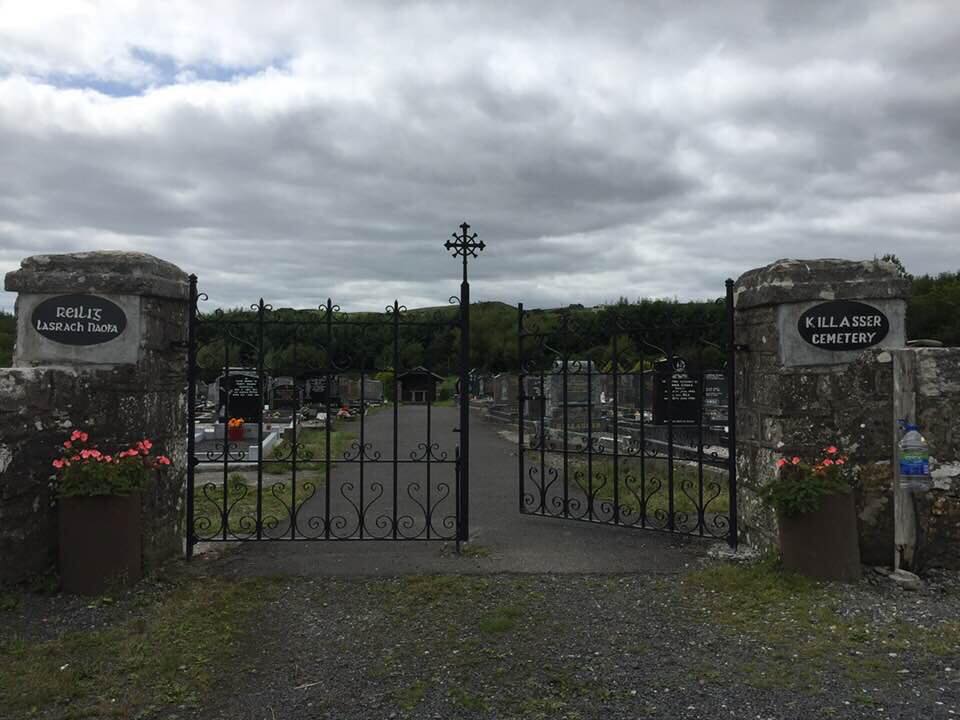
Stopped at the old cemetery to pay our respects to my Great, Great Grandparents in Killasser, Mayo, Ireland. Also stopped at Seamus and Sarah McLoughlin’s house to visit the old homestead. Beer, tea and hot scones. Then onto Foxford Whoollen Mills for some shopping.


Thursday, June 28, 2018

A ride through the town of Hosenfeld, Germany, where my Great, Great, Great Grandfather, Franz Hillenbrand had emigrated. His house was located on the left side late in the video. It is a bucolic German version that is reminiscent of a rural Pennsylvania town.