© 2007 – 2021 William B. Hillanbrand. All rights reserved.

Sunday, January 6, 2019

A series of photographs of Uncle Joe Hillanbrand during WW2. The contents of the letter he sent our Grandfather: Hospital _________France. Jan. 15, 1945

Dear Dad,
How are you and all the kids getting along? Fine I hope. Tell everybody that I was asking for them and hope that they are all doing well. I don't have much to write about, but I wanted to let you know that I am doing fine and kicking with one foot. Dad I asked everybody for Joe R. (That is his cousin Joe Rutledge) address but they never did send it to me, so will you send it to me please? See if you can get Helen or Dot to make me some homemade fudge? I sure do miss it. How are things doing around home, any news? Boy Dad, you sure do get home sick when you are on the front lines, you get to think of everything. The first time since I had been in the army that I had ever gotten home sick and boy I sure was home sick too, but I am ok now, thank God. Boy Dad, to think of the things you go through and still be alive. If I can find the story they wrote about our company on one of its attacks I will send it to you. I didn't think that I would ever come out of that alive, but I went through about 8 more of them and they sure aren't any fun. You can tell Vin that I got that German for him that he asked me to get for him, when he had the bad leg. Dad, now that I seen what I did and that was enough. I don't want you to let Jim go in the service because war is hell and I don't mean maybe either. Well I will close now wishing you all the best of luck & health & God bless all of you.
Your Loving Son,
Joe.


Saturday, January 5, 2019

Another found photograph of my Grandfather's maternal Grandfather (or my Great, Great, Grandfather), Thomas Francis. This is the one to blame for the Hillanbrand eyebrows!


Friday, January 4, 2019

My Grandfather, Francis Joseph Hillanbrand, looking quite the dandy, circa 1920.


Thursday, January 3, 2019

Aunt Lois March Hillanbrand, Aunt Reba H. Gray Hillanbrand, Aunt Helen Hillanbrand Churney, Aunt Nancy Frith Hillanbrand and Aunt Gloria Hillanbrand O'Brien.


Wednesday, August 22, 2018

This is the last of the recent photos that I have for you. This one is a rare one. As far as I know, this is only just the second picture known of our Grandmother, Helen Merial (McLaughlin) Hillanbrand (April 13, 1902 - June 21, 1942). If anyone knows different, please let me know. In this picture, she is standing in front of what appears to be a store front, possibly on Ridge Avenue, in the Falls. She is standing with a young Aunt Dot, circa 1925.


Tuesday, August 21, 2018

This is the third promised picture of my Great Grandmother, Bridget Agnes (nee McNulty) McLaughlin. She was born on March 3, 1861 in Callow, Killasser, Mayo, Ireland. In 1869, her parents , Thomas and Anne (nee Mulligan) McNulty, moved from their farm in Callow to Doonmaynor, Killasser. This was the next townsland, just west of the McLoughlins in Dromada. After James McLaughlin died in 1908, in Philadelphia, Bridget steadfastly raised her family, by herself. She died March 13, 1944, some 36 years after the death of her husband. In the picture below, Bridget is in the middle, date unknown.


Monday, August 20, 2018

Today's picture is not new, however, it is a better copy. It is of my Great, Grandfather James McLaughlin, born April 3, 1861 to Michael McLoughlin and Mary Meer in Dromada, Killasser, Mayo, Ireland. Dromada is the townsland that he was born, which equates to a set of lots in a block, much like a neighborhood in the states. Lots sometimes do not front a road. James married Bridget McNulty on September 13, 1884 in St. Patrick's Church, in Rochdale, Lancashire, England. I don't know why they chose this church to get married, but I believe that at the time, James was temporarily working in England, as often happens when work was scarce back home. James emigrated to the United States in 1889, with his wife, Bridget and two children, Michael and Anna. The rest of their eight other children were born in Philadelphia. James became a fireman, but succumbed to cancer of the stomach on June 21, 1908, at the age of 47.


Sunday, August 19, 2018

Stay tuned for the next four days for some photographs of the McLaughlin family, including an unknown one of our grandmother. In this photograph, taken circa 1901, is my Great, Grandparents, James and Bridget (McNulty) McLaughlin with their children: Michael, Anna, Marie, Catherine, Elizabeth and James. Not pictured is Thomas (born 1889, died 1894), my Grandmother, Helen (born 1902), Agnes (born 1903) and Margaret (born 1907).


Saturday, August 4, 2018

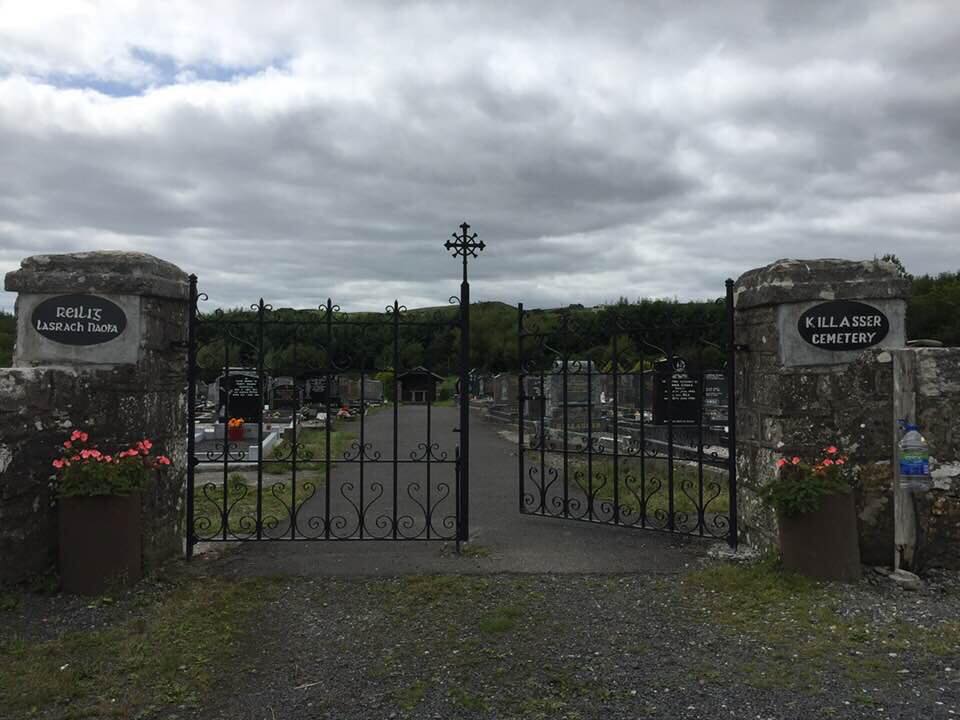
Stopped at the old cemetery to pay our respects to my Great, Great Grandparents in Killasser, Mayo, Ireland. Also stopped at Seamus and Sarah McLoughlin’s house to visit the old homestead. Beer, tea and hot scones. Then onto Foxford Whoollen Mills for some shopping.


Thursday, June 28, 2018

A ride through the town of Hosenfeld, Germany, where my Great, Great, Great Grandfather, Franz Hillenbrand had emigrated. His house was located on the left side late in the video. It is a bucolic German version that is reminiscent of a rural Pennsylvania town.


Wednesday, March 28, 2018

My Great Grandfather's first cousin, Mark McLoughlin and his wife, Mary O'Connor back on the farm in Killasser, County Mayo, Ireland. My Great Grandfather, James McLoughlin left that farm to emigrate to the U.S.


Sunday, May 8, 2016

After 119 years, my Great, Great Grandfather, now has a memorial. Unfortunately, the priest of the parish that owns the cemetery couldn't consecrate the grave. I called and the caretaker said, the priest had passed away and wasn't replaced. Good reason. Anyway, before I left, I placed a small stone on the memorial. Ruhe in Frieden.


Monday, March 14, 2016

Glad I got to meet my Grandmother's second cousin in Ireland last week. They met us with open arms and a warm home. Thanks Seamus and Sarah McLoughlin! It's nice to see they are still at the old homestead. Will have to visit again.


Glad I got to meet my Grandmother's second cousin in Ireland last week. They met us with open arms and a warm home. Thanks Seamus and Sarah McLoughlin! It's nice to see they are still at the old homestead. Will have to visit again.


Wednesday, September 2, 2015

Needed some help from family members in identifying the woman standing next to my Grandfather. Found out it is my Grandfather's sister, my Great Aunt Viola.


Monday, July 27, 2015


Uncle Mike, Aunt Betty (back row), Uncle Vinny, Aunt Dolores and Uncle Ed Hillanbrand, circa 1942.


Monday, May 25, 2015

This flag draped Uncle Tom Hillanbrand and my Dad's caskets. I'm saving it to drape mine and my brother, Mark, in the end. I don't think any other flag would do. It would be nice to have it draped on my Uncle Charlie's casket, if he ever comes home.


Tuesday, November 11, 2014

My thanks also go out to my Uncle Tom J. Hillanbrand, U.S. Army, Korea.


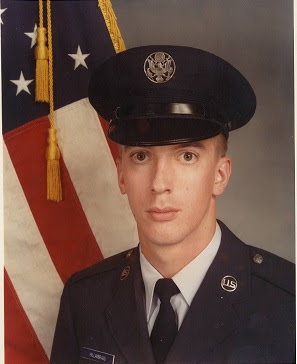
William B. Hillanbrand, U.S. Army, Korea and William B. Hillanbrand, U.S. Air Force. Dad and me.


Thanks to my Grandfather, Francis Joseph Hillanbrand, Private, Company H, 1st Infantry, WW1 and Uncle Joseph P. Hillanbrand, WWII.


Corporal Charles R. Hillanbrand, Company I, 3rd Battalion, 17th Infantry Regiment, 7th Infantry Division, was listed as Missing in Action, while fighting enemy forces on Pork Chop Hill in North Korea on July 9, 1953. On February 10, 1954, his status was changed to presumed Killed in Action Remains Not Recovered. He was awarded the Purple Heart & Combat Infantry Badge.


Sunday, November 3, 2013

As Veteran's Day approaches, I would like to recall the service of my Great, Great, Grand Uncle George William Huth. His record as a Civil War veteran is quite interesting. He entered the service on December 2, 1861, as a private of Company A, Pennsylvania Volunteer Cavalry, and was detailed to Pottsville as a member of the recruiting service from April 3 to 27th, 1862 as an acting sergeant. He was promoted to Artificer of October 27, 1863. During the war he served with the First Brigade, Second Division, Eighth Corps of the Middle Department, from February 3 to July 8, 1863, being transferred then to the Second Brigade, Second Division, Cavalry Corp of the Army of the Potomac, remaining in that brigade till February 17, 1865, when he was transferred to the Third Division of the Cavalry and Military of the Mississippi Army, remaining with that division till July 8, 1865. During the war, Mr. Huth was twice captured, the first time on June 15, 1863, at Winchester, Va., and he was imprisoned on Belle Isle and at Castle Thunder, in Richmond. He was again captured at St. Mary's Church, Va., and imprisoned in Richmond, Danville, Andersonville, Charleston, Savannah, and Florence Hill Prisons till March 1, 1865. He was injured in a fall from his horse on February 14, 1864, his head being injured in the fall. Mr. Huth was discharged from the service on June 1st, 1866. He later was employed as a miner in Schuylkill County. He died on January 12, 1929 at the age of 90, survived by nine grandchildren, seven great grandchildren and several brothers and sisters including, Mrs. Elizabeth Hillanbrand. 


Sunday, March 31, 2013

My Uncle Tom, Dad, Joe Kinsinger, Uncle Frank, Aunt Betty, Uncle Ed, Uncle Vinnie, Uncle Mike, Aunt Dolores and Uncle Ray in 1944.


My Grandfather, Francis Hillanbrand, with my Great, great, grandfather, Thomas Francis, in front of his home at 147 Hermitage Street, in Philadelphia, in 1901.


Sunday, October 10, 2010

Corporal George Zernhelt

Artist rendering of Salisbury Prison Hospital
George Zernhelt was born in 1839 and by 1860, he had come to live with his sister, Magdalena and brother-in-law, Francis Hillanbrand in their home, according to the 1860 census. His occupation at this time was listed of that of moulder. Of course, the Civil War was right around the corner, so George had enlisted into Company E, 55th Regiment of the Pennsylvania Volunteers, which was recruited out of Schuylkill County. He had mustered into service on December 2, 1861. George was 5 foot, 6 inches tall, with blue eyes, dark complexion and dark hair. He must have demonstrated himself during the war, for he was promoted to Corporal on January 5th, 1864. The following, from Bates History of the Civil War, details what would become of George during the end of the war.

"During the night of September 28, 1864, the 55th regiment crossed the James River and marched to participate in the attack about to be made, by the Army of the James, upon Chapin's Bluff. The capture of Fort Harrison was effected on the morning of the following day, but the 55th being held in support of the attacking troops, did not become engaged. In the afternoon it was determined to carry the works beyond, and at 4 o'clock, Colonel Jourdan, in command of the brigade, ordered the 55th to charge, and take a redoubt in the enemy's second line. The 158th New York was deployed to support it, by advancing through the woods on the left, and the 148th New York, to act as skirmishers on the right. The 55th advanced over the open ground in front, a quarter of a mile, under a concentrated fire from three redoubts, supported by a heavy body of infantry. Bravely stemming a torrent of shot, and deadly minnie balls, it moved steadily on, and reached a point within 20 yards of the work, when, its ranks almost annihilated, and supports failing to come up, it was forced to fall back, leaving the dead and most of the wounded upon the field, to fall into the hands of the enemy. Of 5 officers and 150 enlisted men who marched at the word of command, 3 officers and 78 enlisted men were either killed, wounded or missing."

The following facts of memorandum was collected regarding Prisoner Of War Records: George had been captured at Laurel Hill, near Chapins Farm, Virginia on September 30, 1864. He was later confined at Richmond, Virginia, September 30, 1864, then transported to Salisbury Confederate Prison, in North Carolina on October 9th  1864. The real misery for the prisoners at the Salisbury Confederate Prison began in the fall of 1864. The Prison compound designed for 2,500 men was forced to handle four times that many. Due to the Union Naval blockade there was a shortage of medicine and medical supplies which resulted in terrible suffering of the prisoners and needless deaths. Throughout the South there was a shortage of food and the Prison was no exception. Eventually, all the buildings were taken over for hospital use, and the men were forced to seek shelter that cold, wet winter under the buildings, in overcrowded tents, and in burrows dug into the hard red soil. The death rate that had been only 2% before October 1864 skyrocketed to 28%.

Recently captured soldiers and transferred prisoners from other areas increased the number held at the Salisbury Prison to 5,000 by October 1864. Ten thousand men were crowded into the stockade by November and conditions began to change dramatically. Burials before the overcrowding had been in coffins and in separate graves. Records exist that indicate military burial services were even given. However, due to the large number of men dying daily after October 1864 a mass burial system was initiated. The bodies were collected daily and taken to the “dead house” to be counted and loaded onto a one-horse wagon. At 2:00 PM each day this wagon of the dead would be taken about ¼ mile to an abandoned cornfield where the men were buried. Eighteen trenches of approximately 240 feet each were eventually needed.

Salisbury National Cemetery
George would never again see his family. He was admitted to the prison hospital on January 10th, 1865, wherein he later died January 16th, 1865 of debility. He is among those buried in one of the sacred trenches with thousands of his brother soldiers.

Bibliography

Bates, Samuel P. (1902). History of the Pennsylvania Volunteers, 1861-65.

Salisbury Confederate Prison Association (2010). Prison History. Retrieved from http://www.salisburyprison.org/PrisonHistory.htm